
That which cannot be said.
A music filled weekend.

San Martín, Calchaqui Valley, Argentina
November 11th, 2025
“Music expresses that which cannot be said and on which it is impossible to be silent”
-Victor Hugo
Dear Reader,
On Friday I headed to Salta for the weekend while Adrien and his parents returned to San Martín. That evening I attended the Festival de Coro de Argentina. Choral groups from around the country had traveled to Salta to perform on Friday and Saturday night at the Cultural Center.
There were groups of just women, groups of the “tercer juventud” - third youth - and mixed groups of all ages. A few men played the drums, and the choir directors, both men and women, played the guitar, or a piano, or directed with their arms with prerecorded tracks for accompaniment.
A group of youthful elderly people from the region of the Chaco came out all dressed in black. They each had a brightly colored scarf tied round their necks. An old woman with curly, shoulder length gray hair and red lips walked assuredly across the stage.
She introduced the group, the choir director, and the songs they’d be performing. Then she took her place in the choir.
In the lobby afterwards I congratulated her.
“I really enjoyed the show.”, I said.
“Thank you, niña.”, she replied. “Do you know that I am ninety three years old?”.
“No.”, I said. “Congratulations all the more.”.
“Life is to be enjoyed.”, she said. “Make sure you enjoy it.”.
One of the choirs performing on Friday night.
The next night I went to see a bandoneon artist perform. A bandoneon is an accordion type instrument typically used for tangos.
The artist, Rodolfo Mederos, has garnered a huge following during his decades long career, and is in his eighties now. He traveled from Buenos Aires to perform for two nights only in Salta.
There was no singer, and he sat alone on the stage with his bandoneon. He introduced the songs, giving us a little bit of the history behind them, and talking about his own life too.
“Music has been my whole life.”, he said. “Through music my children came into the world, my friendships were formed; I was able to visit countries I’d only dreamed of. Because of my love for music I’m here with you tonight.”.
After reminiscing about the composer Astor Piazzolla, he launched into a rendition of one of his most famous tunes called Adiós Nonino - Goodbye Grandfather. Piazzolla wrote it in 1959 following the death of his father who was nicknamed Nonino.
Here’s a short video my friend took.
Rodolfo Mederes plays Adiós Nonino.
On Sunday I made the drive back and this afternoon we returned once more to Salta, passing through Cafayate.
Along the way we stopped at a huge natural rock formation called Devil’s Throat. You can find plenty of photos of this natural wonder online so instead I’ll share with you a photo I took of the trash can. It struck me because it was so heavily covered in stickers from tourists who’d stopped there over the years.
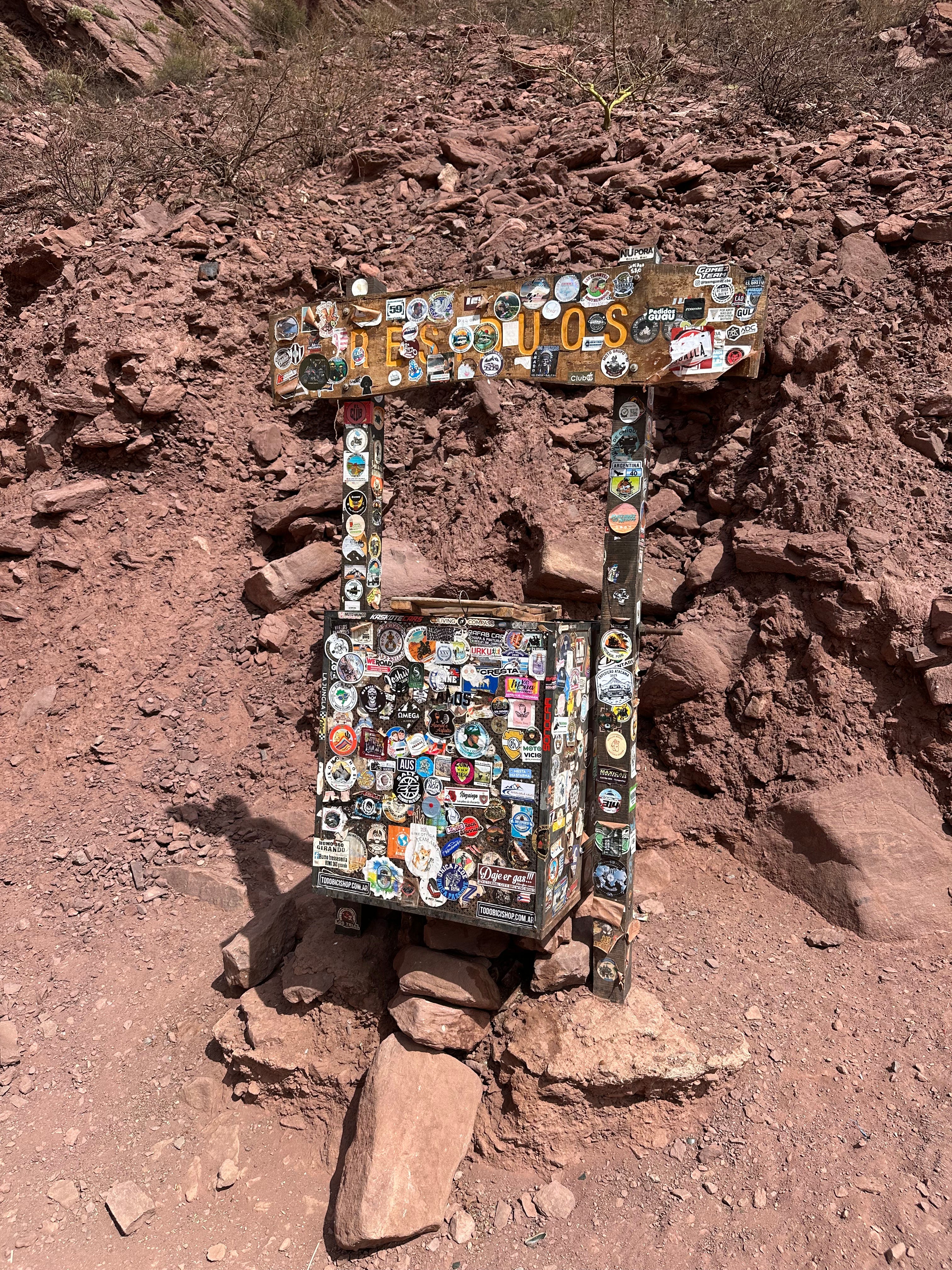
The trash can at the Devil’s Throat. Route 68 from Cafayate to Salta.
More to come.
Abrazos,
Mariah
Usually, when I take a photograph of a trash can, it's by mistake. But this was a rare time I know of someone INTENTIONALLY taking a photograph of a trash can!
Looks like a beautiful falls Mariah. I now understand all of the different stickers on the trash can, many, many visitors.